Showing posts with label Editorial. Show all posts

Wednesday, October 18, 2017

DM Crash Course 102 - Session Length, Encounters & Treasure

Introduction

Hello and welcome back to the second installment of DM Crash Course!  Today we will be covering the three major categories that help spice things up in your campaign by introducing two tools that I normally use and a short table that helps me measure how long my session will be.  In the previous session we discussed world building, building a flow chart for your story and finally drafting your first town, so primarily this will be affecting both our first and second process: World Building and Our Flow Chart.

Session Length

A session can range anywhere from a quick 30-60 minutes to a twelve hour power quest.  It just depends on how large your group is and how many encounters the party is facing or will be dealing with.  In general I use the rule of thumb in the following for a group of 4-5 adventurers and assuming that all of the encounters are set to a medium difficulty:


Time of Session # of Encounters
>= 30 minutes 1
30-60 minutes 2
60-120 minutes 4
120-180 minutes 8
180-240 minutes 12
240-300 minutes 16
300 minutes+ 16+


If your group happens to be larger you will have to shift down the total amount of encounters, because more players means more thought and conversation, here is a modified chart for a group of 6-8 adventurers:
Time of Session # of Encounters
>= 30 minutes 1
30-60 minutes 1-2
60-120 minutes 2-4
120-180 minutes 4-6
180-240 minutes 6-10
240-300 minutes 10-12
300 minutes+ 12+

Now that we have an official number for encounters you might be asking yourself, while designing, what constitutes as an encounter, and in general, that could be anything that poses a risk to the adventurers and will reward experiences in one value or another.  You might also be asking yourself what constitutes difficulty? Well onwards to explain Kobold Fight Club and shifting encounters upwards or downwards in difficulty.

Encounters

Get ready to bookmark your new favorite tool when it comes to designing an encounter with monsters: https://kobold.club/fight/

Kobold Fight Club allows you to quickly build an encounter for your party, but the drawback is that it does not have the stat blocks for any of the creatures.  So you will need to at least have access to the books you are looking up or using for a source.  So let's play pretend and assume that we do not have a computer, a smartphone, or the internet and have to design an encounter by hand.  Assuming that you have a party of 5 adventurers that are all at level 1 we will be working on designing an easy, medium, hard and deadly encounter.  I want to take our mascot, kobolds, as our adversary but do not know how to balance an encounter.

That means that if you threw 12 kobolds at a level 1 group, they would be dead.  If you threw 2 kobolds at the group, they would squash them in the first round.  So how do we figure out what the core number is?  The first step is to look at the CR rating of a kobold, in this case it is a CR 1/8. CR, or Challenge Rating, is deviously deceptive in Fifth Edition, but if you look at the total party number you can ascertain that 1 player could easily kill a kobold before the kobold kills them.  So we can assume that our party can easily take on a group of kobolds between 2-4 and rightfully so.  That would be considered an easy encounter.

A medium encounter would be between 5-6 kobolds.  That means the party could potentially die, or at least one member could drop to zero quickly.  This is where you should strive to build encounters.  Any higher or lower will either bore the group or potentially wipe them out, but in case you are wondering 7 kobolds would be considered a hard encounter.  Someone will die or at least be dying and there is a potential of a party wipe.  From 8+, the party will potentially die or multiple members will die.

Another way to handle encounters, if you don't want to run a bunch of creatures at once is to use one big creature or mix your encounter.  An example of a medium encounter using kobolds would be: 2 kobolds and their pet crocodile (CR 1/2).  The group could also handle a CR 1 monster to themselves as a medium encounter, like an animated suit of armor with a kobold.

I implore you to go play with Kobold Fight Club and get an idea of what is the right challenge for your party.

Treasure

Now, you've made it to the end of your session and you have all of these grumpy, grumpy players who had died, almost died are dying and/or were never touched, rubbing their hands together in hopes of gathering glinting and glimmering glory.  There are several ways to approach this and this all depends on your setting.

A high magical campaign might see potions and scrolls as a common reward in treasure with the occasional magical item.  Magical items are considered not as rare as normal and even NPCs and monsters could be wielding them on the battlefield.

A medium magical campaign uses potions and scrolls with a mix of more monetary coinage and gems.  This is about average road.

A low magical campaign rarely sees a potion or scroll and magical items are a process of exploring high and low and in hopes of maybe finding that +1 long sword after five or six levels.  Most rewards tend to be coinage, gems, arts, etc.

So, because we live in a technological era let us look at: http://donjon/sh/5e

Here it allows you to roll for treasure, trinkets, magical items, anything.  The real key is to match your treasure with the encounter or session difficulty.  Did your party raid a castle? Roll two or three hordes as the session treasure.  Did your party just kill bandits? Roll a few treasure rolls and choose/roll a 1d10.  It is a super easy and quick way to keep the game moving without bogging the game down to go through books to look at tables, to roll on tables, to determine that the tables are correct.

Join me next week as I talk about characters, variant rules, and the dreaded Session Zero.

Monday, October 16, 2017

Does Alignment Matter? The Argument Against Alignments


If there is anything more true to the statement above, it would be that water is, in fact, wet.  Alignment has been a core identity for Dungeons and Dragons since it's core incarnation underneath Gary Gygax's Dungeons and Dragons and Advanced Dungeons and Dragons, and in most circumstances it is the reason and drive on how most roleplayers play their character.  Now, what if I told you, alignment doesn't really matter in the idea of how a character is roleplayed, as long as it is an anchoring point.

Alignment in Fifth Edition is extremely tensile, outside of some spells, abilities and roleplaying monsters [#notallmonsters].  The core idea that Lawful Good the Paladin alignment was thrown out in the favor of allowing the Paladin to follow his core edicts, which he attains at level 3, or that Druids are all neutral and Monks are always lawful have been thrown to the wind for the sake of just roleplaying.  Depending on your Dungeon Master, A Paladin may now be Lawful Evil or even Chaotic Evil and still be considered Paladins. A Barbarian can now be Lawful Good, following laws of society or of a king for the sake of helping his or her village and Druids are allowed to project more urgency having aspects ranging outside of neutrality.

The major problem that I have always had with alignment is that a player character is and should be dynamic, especially when progressing through a campaign or leveling up.  I always think about two literary examples when it comes to alignment changing over time: Conan the Barbarian and Anakin Skywalker.  These two individuals spent much of their core story changing and developing.  Conan shifts from a savage slave to that of a warrior king and conqueror.  Anakin shifts from a slave child to a Jedi with questionable values to one of the most memorable villains created. So what stops a player from developing the same way from level 1 to level 7?  Let's take a more detailed look at Anakin's story.

At first, in this case Episode 1, he is just a naive kid who wants to do good, because he can and doesn't adhere to laws: Anakin is Chaotic Good. He just wants to help.  In Episode 2, we see that Anakin begins to slip in alignment as he matures, seeing that some edicts of the Jedi Order are holding him back from love, rescuing his mother, that he is willing to do what is necessary for him to get what he wants, including genocide: Anakin is now Chaotic Neutral or even Neutral Evil.  It wasn't until his full conversion to Darth Vader in Episode 3 that he gains the alignment of Lawful Evil, following the will of his master and doing whatever it takes to complete that task, in this case: Murdering younglings, hunting Jedi and even applying the penalties of law "fairly" on individuals, but usually without mercy.

In most circumstances, I think it is a good thing to always question your character's alignment as a player and at any point you feel that actions determine a change, ask your Dungeon Master to shift to another alignment to help better represent your character.  I personally like the idea of the story driving my character's alignment, maybe at one moment he was a Chaotic Good Rogue who hustled hustlers and then was hired or incorporated into a band of lawful individuals who, through multiple sessions, began to understand and appreciate the laws that his comrades followed and eventually adhering to their laws, but rarely bending back to his ways of out gambling hustlers and swindlers to give back to those in need.

Still, one of my favorite alignment charts.

Friday, October 13, 2017

1-Hour Sessions: Grave Robbers (Level 1 encounter)

Introduction

Hello and welcome to the first post in 1-Hour Sessions, here I will provide all of the core material needed to take a group of up to 5 adventurers through one adventure of Dungeons and Dragons, without having any experience.  I will provide the encounter map, the encounter & experience, and the treasure for every session.  This will allow you to either take this up as a quick sidequest, a hook, or even the beginning of your own campaign.

The Scenario

In Grave Robbers players will be introduced to the Caretaker to the local graveyard who has been complaining about graves being dug up and raising his superstition that the undead will strike against him and the town if digging doesn't stop.  He promises the party a large collection of potions, oils and other similar trinkets if the party can stop whoever or whatever is digging in the middle of the night.

Your first step should be getting to know who your players are, or at least their characters.  Go around the table and have all of them introduce themselves and have them keep it short.  If this isn't your first session, then ignore this step.

Here you will be given the brief script that the caretaker will use with the players:
Intro hook: "P-please, help me. I fear for my life if they aren't stopped."
Answering their question: "I am the caretaker of the graveyard, S-s-simon.  S-someone or something has been digging up the graves in the middle of the night...I-if they aren't stopped, we're all doomed.  The dead will demand vengeance for disturbing their sleep. I c-can re-reward you if you save our town."
The party should get the idea that that the caretaker is either a fragile person, superstitutious, simple, or even elderly with the stuttering and it plays on the idea that it would be good to not only help the caretaker, but also prevent skeletons and zombies to ravage the town.
Answering a question about reward: "I have a c-cache of potions, oils and and ointments you can have, just stop them before it is t-t-too late!"

Explaining the Map


The map comes with 8 rooms in total, two of which are blocked by locked doors.  Each number has a flavor description which may or may not be read at your choice and are just optional ways to describe the room.  At any point you feel comfortable, you can just ad-lib the descriptions.  Here are the scripted descriptions:
  1. "Easily entering the sepulcher, the dim torchlit hallway holds a somber tone of respect as it is met with the spine-tingling smell of earth.  Echoing off the walls are the sounds of boots and whispers.  The hall way extends 75 feet inward and to your left and right are open doorways with more doorways visible through the dancing shadows of torches."
  2. The room seems undisturbed as six large sarcophagi sit in the room.  You recall the warning that Simon, the caretake had told you before.
  3. The room looks like it was recently disturbed and the sounds of scratching can be heard within in the coffins.  It almost sounds like nails scratching against their oaken lids and faint gasps can be heard.
  4. Inside the room, you see two statues with braizers lit, but giving off a strange blue flame.  There are two sarcophagi below them and two chests nearby.
  5. Ten coffins sit in this room and are accompanied by a wheelbarrow and a chest.  It is obvious now that someone has been here before as the same sound from the coffins before can be heard in a louder chorus in this room.
  6. Entering this room you see two large statues that look like they belong to a noble person.  Two chests sit at their heads and their sarcophagi are decorated with personal belongings and weapons.  You get the feeling disturbing this room may lead to a grave mistake.
  7. Entering this room, the smell of heady wines, dust, grave dirt and sweat assault you.  There are several crates that look like were moved around earlier in the day.  You can assume that this is the caretaker's storage.
  8. A chest sits on top of a large altar that has runes and arcane symbols sketched around its base.  Whatever is in the chest most either be important or worth something, but is it worth it?
Notes:
  • All of the doors that require to be unlocked should be a Difficulty Check of 15 with Thieves' tools.
  • Opening a sarcophagus requires a Strength Check of 14.
  • The coffins in room 3 & 5 contain skeletons and if disturbed or opened become hostile.
  • The chests in room 4 contain 300 gold pieces in gems, but when disturbed raise 2 ghouls from the nearby graves.
  • The chest in room 5 contains jewelry, coin, gems and an ornate dagger totaling in worth of 450 gold pieces.  Taking any treasure of this chest would awaken ten skeletons, bursting from their coffins.
  • The chests in this room contain 500 gold pieces in jewelry and gems.  The personal items are worth a total of 200 gold pieces.  Taking any treasure from this room will raise two wights, which are deadly to these characters at the moment.
  • Entering the caretaker's room has no penalties outside of a moral quandry.  The party, searching the crates find three bottles of holy water and several small trinkets, but nothing of value.
  • The chest on the altar in room 8 contains a magical amulet, but opening the chest also releases a ghost, which is deadly at this level.
  • When the party enters room 8, have them roll a Perception check to notice stomping footsteps.  The check for this should be a 12.

Running the Encounter

The encounter with the grave robbers is a fight against 5 bandits.  This is a medium encounter, which means that the bandits should be of an equal level to the party, no one should die, but it may happen with bad rolls.  The fight in total is worth 250 experience points, and it is up to you whether or not you divide it between the players or give it as a lump sum.  I generally will divide experience, so each play in this case would get 50 experience points for surviving the encounter.

To make it easier on your party, have the bandits each attack a different target on their turns.  Some bandits may engage in melee combat, while others stay at ranged.  It is fine to mix it up.

Here is the stat block for the bandits:
Bandits are a staple in robbery for both GP and HP.

Conclusion

If the party did not disturb any grave site award them each 100 experience points.  At this point it leaves to question who the men were looking for, could they be working for someone else? What about all of the coffins filled with animated skeletons?  You can leave the party with all of the questions they want, but the best hook for your next adventure is leaving them wondering until next session.

If you are looking for pre-generated characters, you can find them here.

Tuesday, October 10, 2017

DM Crash Course 101 - World Building, Flow Chart Brainstorming, Drawing a Town

Introduction

So you made it to the big leagues, or your friends pressured you into running the game for them for the very first time.  First off, congratulations on one of the funnest parts of Dungeons and Dragons, secondly, get ready for some of your campaign to not be done or done at all.  That is not a bad thing, but it can get tedious to constantly modify your campaign or work on the fly if you are new.  In this entry I am going to go over the three phases that I use to create a campaign.

Time to get a few materials: Lined paper, some printer paper, a pen or pencil and maybe a hi-lighter or three.

Expect 5 more sections to be updated once a week, each addressing three new topics.

Deciding Where Your Campaign World is

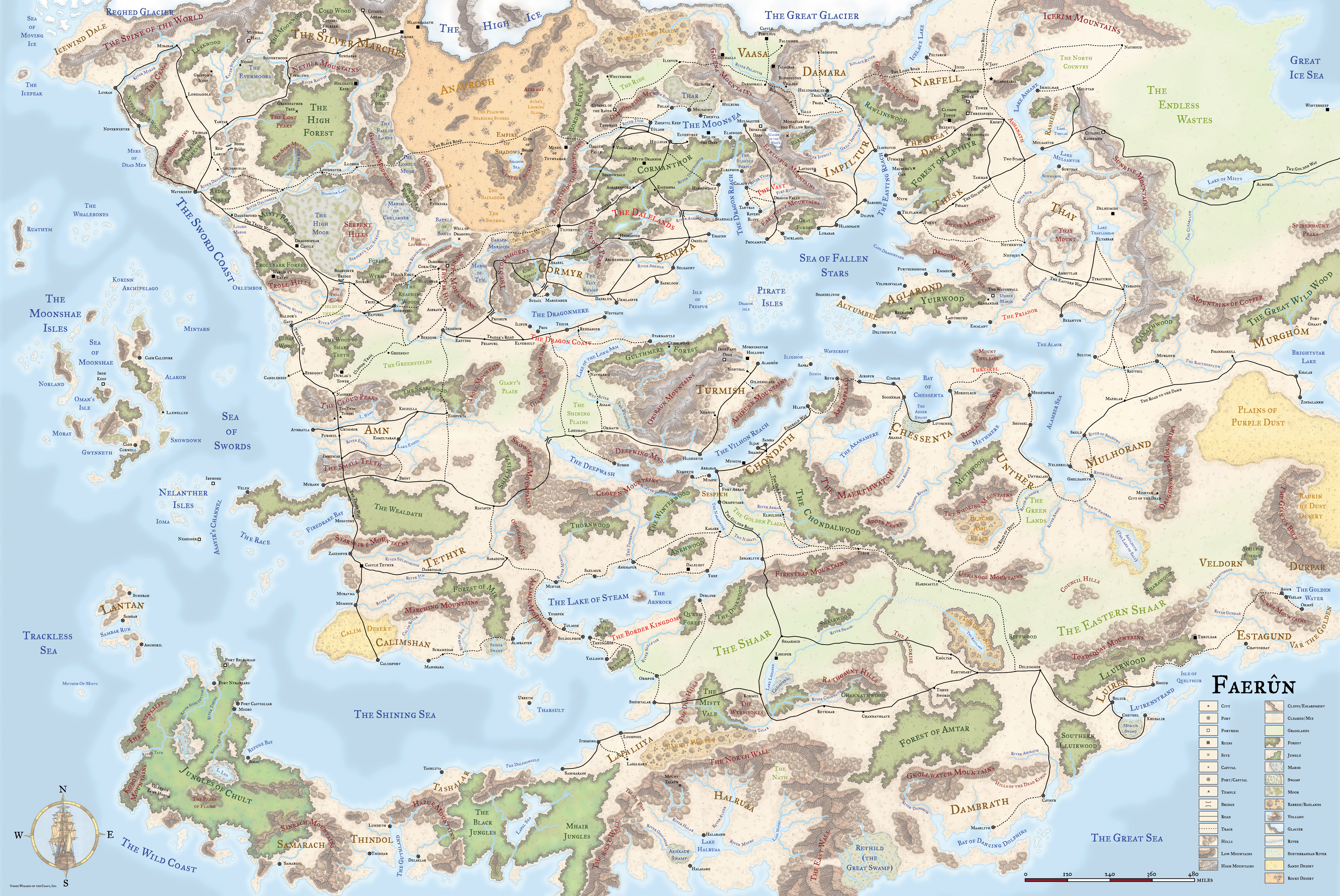
A full map of Faerun, the official campaign map.
It can be found here for download:
http://www.pocketplane.net/volothamp/images/faerunlarge.jpg

If you are new to Dungeons and Dragons, you might be asking yourself, "Is there an established world?" Or "Is it alright to create my own world?"  The answer is yes and yes.  In the current iteration of Dungeons and Dragons (Fifth Edition), the world has several official campaign books that take place in the Forgotten Realms setting.  The most current campaign out is Tomb of Annihilation, and is very much worth playing or at least looking at for ideas in your own world.  

Forgotten Realms is also rich with maps, lore, ecosystems and adventures that have been created, ran to the ground and then ran again.

Creating your own world is easy if you take the idea of starting small and building large.  I'd almost always advise starting with building a town, but if you want to start a little larger, start with an island.  Islands allow you to use water as a natural border until you are ready to expand to a cross-continent adventure and should provide enough content for players up to 5-7-9-20 with enough imagination and the right party.

Flowchart Brainstorm

Once you get at least a rough idea of what your world is and whether or not you are going to use an official campaign or not, you can begin to start plotting out your campaign.  I am a firm believer of the episodic play, because it allows players to drop in and out between your campaign without having much fuss of not being able to play and having the potential to have new players each session if needed.

A flowchart is as what it sounds by design as an example (Google Drive FlowChart) I have create a very simple three episode campaign with the theme of undead, necromancers and a risen hero turned evil and a potential arc to a follow-up campaign.  The campaign is mostly built around undead, some cultists and a couple of boss villains.  I also noted down key treasure that would keep the campaign iconic that I would like to use or something similar to that.  The campaign would take three sessions to complete and making sure to have a hook or hint to a future campaign that might take place next time.

A flowchart design also allows you freedom to create twists and turns on the formula given.   As an example, here is the above flowchart modified for two more adventures and the reason why the town is under attack. Expanded FlowChart.

Drawing a Town

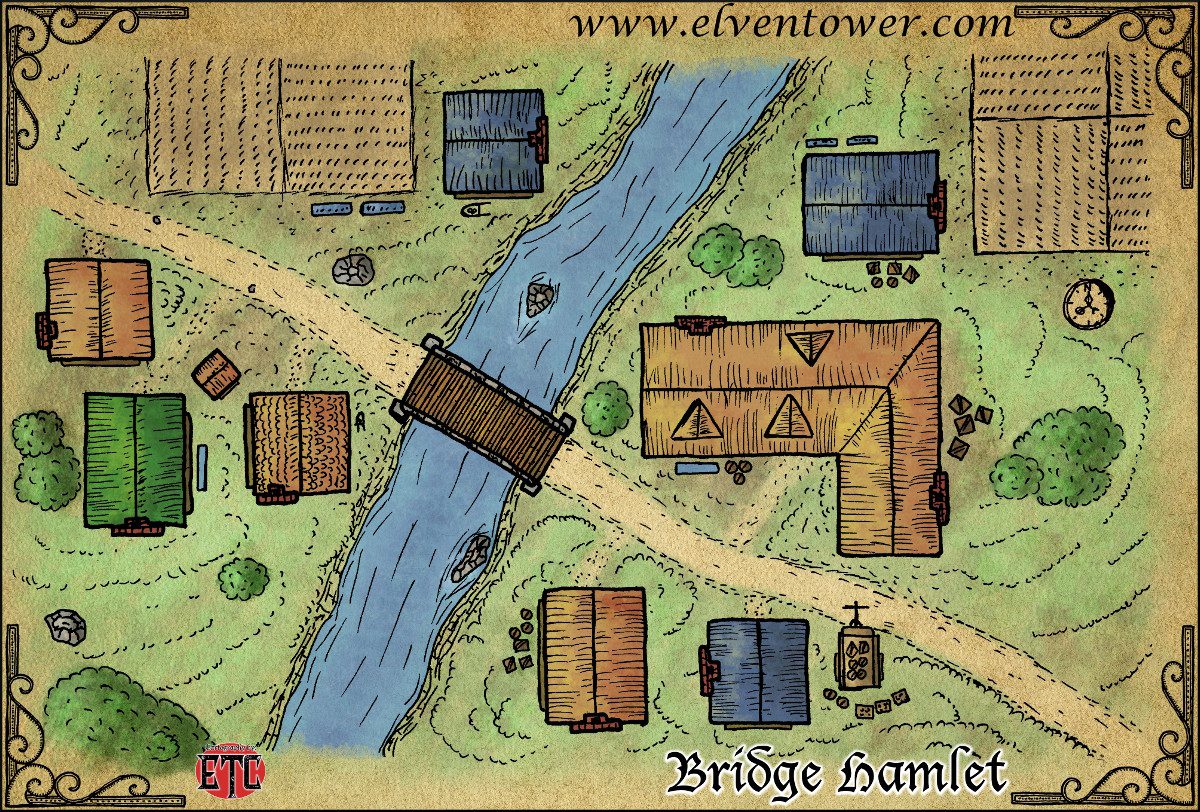
From www.elventower.com

I feel, and this is personal, that every town should have the village should have the following: Food sources (I use large plots that are fenced into to represent fields or livestock), houses and at least one tavern with a great name.  In my current campaign, I use the tavern name of: the Defeated Pillow and usually use double entendre with taverns and inns. It helps create the idea of the environment and also allows for characters of multiple backgrounds to rummage in for a food, drink or story. If you are not that creative with names, here is a website that can generate those names for you.

When my players are low level, I adore the idea of them growing from the village/hamlet and being thrust into the bustling big cities, but I digress.  Other key features that should be addressed in your little hamlet or town should be a lord, like a knight, a sheriff, a noble or an elected elder whom the party can build confidants with and a few shops that provide general goods and a basic smithy.  These standard shops for me are a blacksmith, a stable and potential curio store or general store if the area has been rich with adventures before.

Varus Journal, Entry #12: The Rise of Greystone Keep

Once we cleared out Greystone Keep and the haunted village, we spent a long night drinking and discussing what to do next. At the end of t...